

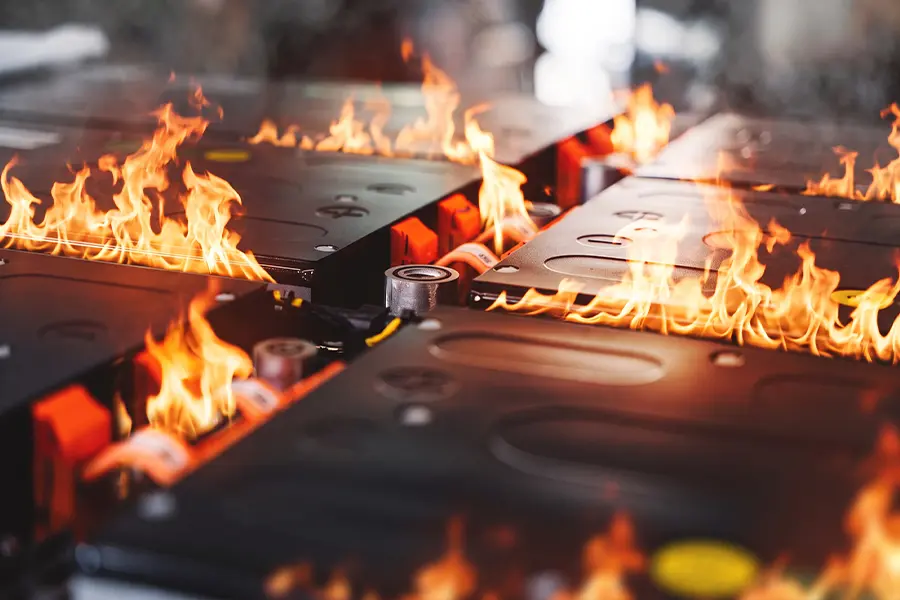
With the growing number of electric vehicle users in recent years, the term lithium-ion battery has become increasingly familiar in everyday life. Yet this technology is also found in many of the electronic devices we use. From electric vehicle batteries and forklifts charged inside warehouses to energy storage systems and portable electronics, the same underlying technology is used across a wide range of applications. High energy density and rechargeability have made these batteries one of the primary energy sources in many industries. However, as the amount of stored energy increases, safe charging, monitoring, and protection against potential failures become even more critical.
In facilities with large battery packs, the risk is not limited to a single cell overheating. A failure that begins inside one cell can spread to others, potentially releasing flammable gases, producing dense smoke, and creating a risk of re-ignition. To assess lithium-ion battery fires properly, it is therefore important to understand how the technology works and which safety measures help keep risks under control.

What Is a Lithium-Ion Battery?
A lithium-ion battery is an energy storage system that stores electrical energy as chemical energy and operates by moving lithium ions between electrodes during charging and discharging cycles. Unlike conventional single-use batteries, it can be recharged repeatedly under suitable conditions. Compared with lead-acid batteries, lithium-ion batteries generally offer higher energy density and lower weight. A lithium-ion battery has four main components: a positive electrode (cathode), a negative electrode (anode), an electrolyte, and a separator. The cathode and anode contain electrode materials in which lithium ions are stored. The electrolyte enables ions to move between the two electrodes, while the separator allows ions to pass through but prevents direct contact between the electrodes. This separation is essential for battery safety. Damage to the separator or an internal short circuit caused by a conductive foreign material, such as metal particles, may push the cell outside its normal operating conditions. Such a failure can become a serious safety hazard, particularly when heat generation cannot be controlled.
How Does a Lithium-Ion Battery Work?
Lithium-ion batteries store electrical energy as chemical energy, making it available for later use. Their operating principle is based on the movement of lithium ions between two electrodes inside the battery. To understand this process more clearly, it helps to look at the main stages of energy storage and transfer.
Charging Stage
When the battery is charged, electrical energy supplied from an external source drives lithium ions from the positive electrode toward the negative electrode. The ions travel through the electrolyte and are stored at the negative electrode. Meanwhile, electrons move through the external circuit, allowing energy to be stored in the battery. Charging must take place within the voltage and temperature limits specified for the battery.
Discharging Stage
When the battery supplies power, lithium ions move from the negative electrode toward the positive electrode. Electrons travel through the external circuit, generating the electric current required to operate the connected device or system. During this process, the chemical energy stored in the battery is converted into usable electrical energy.
What Are the Key Features of Lithium-Ion Batteries?
The performance of a lithium-ion battery is not determined solely by how much energy it can store. Weight, charging time, power output, cycle life, and response to temperature changes also influence where it can be used. The table below outlines the main technical features of lithium-ion batteries, their advantages, and important considerations during use.
| Feature | Technical Explanation | Why It Matters in Practice |
|---|---|---|
| High energy density | Stores a large amount of energy per unit of weight or volume. | Offers a weight advantage in electric vehicles and portable devices. |
| Rechargeability | Supports repeated charge-discharge cycles under suitable operating conditions. | Enables reuse and helps manage operating costs. |
| High efficiency | A substantial portion of the energy supplied during charging can be used again. | Reduces energy losses; actual efficiency depends on system design. |
| Low self-discharge | Loses stored energy more slowly when not in use than many conventional battery types. | Provides advantages for storage and standby applications. |
| Temperature sensitivity | Excessive temperatures can negatively affect performance and cell lifespan. | Increases the need for thermal monitoring and adequate ventilation or cooling. |
| Chemistry-dependent safety characteristics | Chemistries such as LFP and NMC have different thermal and electrical properties. | Battery selection and fire scenario planning must account for battery chemistry. |
Where Are Lithium-Ion Batteries Used?
Lithium-ion batteries are used in many applications, from portable devices to electric vehicles and energy storage systems, because they can make stored electrical energy available when needed. As their range of applications expands, battery capacity, installation methods, and safety requirements also vary. The most common applications include:
- Electric vehicles: Store traction energy in cars, buses, and commercial vehicles.
- Industrial vehicles: Used in forklifts, warehouse handling equipment, and some autonomous mobile robots.
- Energy storage systems (ESS): Support solar and wind energy storage, grid balancing, and backup power.
- Consumer electronics: Found in smartphones, laptops, tablets, and wireless devices.
- Uninterruptible power supplies (UPS): Provide power to critical systems during electrical outages.
- Industrial equipment: Used in portable measuring instruments, professional power tools, and various autonomous systems.
How Long Does a Lithium-Ion Battery Last?
The lifespan of a lithium-ion battery depends on its chemistry, frequency of use, charging habits, temperature, and the operating limits defined by the manufacturer. There is no single lifespan figure that applies to every battery. Battery lifespan is generally assessed in two ways:
Cycle life: The number of charge-discharge cycles a battery can complete before its capacity falls to a defined level. One full cycle can represent cumulative energy use equivalent to the battery’s capacity; it does not have to occur all at once.
Calendar life: Chemical aging that occurs over time, even when the battery is not in use. Manufacturers often define cycle life according to a threshold, such as a decline to 80% of the original capacity. This threshold is not a safety guarantee; it is a performance measure indicating a reduction in the battery’s energy storage capacity.
Several factors can shorten battery life. For example, leaving a battery in a hot environment for extended periods, keeping it continuously at a full state of charge, and charging it at unsuitable current levels may accelerate aging. Charging in cold conditions, especially below the limits allowed by the cell manufacturer, may lead to metallic lithium deposits on the anode. Under certain conditions, this can increase the risk of an internal short circuit. A loss of battery capacity does not automatically mean the battery poses a fire hazard. However, unusual heating, swelling, odors, leakage, mechanical damage, or repeated fault warnings may indicate that the battery should be taken out of service and inspected by specialists.
What Causes a Lithium-Ion Battery Fire?
A lithium-ion battery fire often cannot be attributed to a single cause. Electrical faults, mechanical damage, improper charging, high temperatures, or manufacturing defects can trigger uncontrolled heat generation inside a cell. The severity of the risk depends on how the initial failure develops and whether heat spreads to other cells. The main contributing factors include:
Exceeding a cell’s permitted voltage limits, using unsuitable charging equipment, or experiencing a protection-circuit failure can trigger hazardous reactions. Overcurrent and short circuits can also generate heat rapidly.
Vehicle accidents, forklift collisions, dropped batteries, or improper installation may damage a cell’s internal structure. A lack of visible external damage does not necessarily mean the cell is undamaged internally.
Unwanted metal particles between electrodes, separator damage, or other internal defects can create conditions for an internal short circuit. Some of these defects may not be readily apparent during initial use.
Storage in hot environments, insufficient cooling, heat transferred from neighboring cells, or high-current operation can raise cell temperatures beyond the safe operating range.
Increasing internal resistance, capacity loss, and cell imbalance can make operating conditions more challenging, particularly when combined with incorrect charging or inadequate thermal management. Aging alone, however, does not mean every battery will catch fire.
What Is Thermal Runaway?
As electric vehicle fires receive increasing attention, the term thermal runaway is being heard more frequently. But what exactly is thermal runaway, and why does it occur? Thermal runaway is a process in which the temperature inside a lithium-ion battery rises uncontrollably and the heating accelerates itself. Chemical reactions inside a battery cell generate more heat. The rising temperature then triggers further reactions, causing the process to intensify. This can lead to ignition, the release of explosive or flammable gases, and the spread of fire to other cells. Thermal runaway may be triggered by overcharging, a short circuit, physical damage, or high temperatures. One of the greatest risks is that heat originating in one cell can spread to adjacent cells and develop into a larger fire. For this reason, lithium-ion battery safety requires temperature monitoring, early warning systems, and protective measures designed to limit the spread of fire.
How Should a Lithium-Ion Battery Fire Be Managed?
During a lithium-ion battery fire, preventing heat from spreading to other cells and reducing the risk of re-ignition are just as important as controlling the flames. Ongoing chemical reactions inside the battery cells mean that the disappearance of visible flames does not necessarily indicate that the danger has passed. The appropriate response therefore depends on battery size, the surrounding environment, and the stage of fire development.
Nivofire Li-iON Battery Fire Limitation Blankets are among the solutions developed to help control battery fires and limit their effects. Made with a multi-layer fabric structure designed to withstand high temperatures, these blankets can be used in facilities where lithium-ion batteries are manufactured, stored, maintained, or repaired, as well as in recycling areas and electric vehicle production facilities. The product is designed to help suppress flames and limit the spread of smoke and gases. The primary purpose of a battery fire limitation blanket is to restrict the spread of a fire’s effects by covering the affected area under appropriate conditions. However, using a blanket does not guarantee that thermal runaway inside the cells will stop or that the battery will not reignite. Battery fire limitation blankets must therefore be used alongside other fire safety measures and professional emergency response procedures.
Frequently Asked Questions
How Many Years Does a Lithium-Ion Battery Last?
The lifespan of a lithium-ion battery varies according to frequency of use, cell chemistry, charging habits, and operating temperature.
Why Do Lithium-Ion Batteries Catch Fire?
Overcharging, short circuits, physical damage, manufacturing defects, and overheating can trigger uncontrolled chemical reactions inside a battery. These reactions may develop into thermal runaway, creating a risk of fire and gas release.
Can a Lithium-Ion Battery Explode?
Yes. Heat and pressure building up inside a battery can cause flammable gases to be released and, under certain conditions, lead to ignition or an explosion.
How Should a Lithium-Ion Battery Fire Be Managed?
The area should first be evacuated and emergency services notified. The response method depends on the size of the battery and how the fire is developing. In suitable scenarios, Nivofire battery fire limitation blankets can help limit the spread of flames and other fire effects.
Is a Swollen Lithium-Ion Battery Dangerous?
Yes. Swelling may indicate gas formation inside the cell and a developing battery fault. The battery should not be used, charged, punctured, or compressed.
How Should Lithium-Ion Batteries Be Stored Safely?
Batteries should be stored in a dry place, away from direct sunlight, at temperatures specified by the manufacturer. They should be kept away from heat sources and flammable materials, and their terminals should be protected against short circuits. For batteries that will remain unused for extended periods, the manufacturer’s recommended state of charge and inspection intervals should be followed.
Can a Lithium-Ion Battery Fire Reignite?
Yes. Residual heat or ongoing chemical reactions inside cells can lead to re-ignition after visible flames have been extinguished. Battery temperature should therefore be monitored after a fire, and the battery should not be returned to normal use or transported until specialists have confirmed that it is safe.