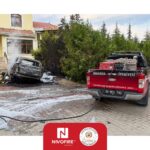
A fire often begins not with a major explosion, but with a pan left unattended in the kitchen, an appliance plugged into an outlet, or a few seconds of carelessness. A small flame that may seem controllable at first can turn into a serious incident threatening homes and workplaces within minutes if it is not handled correctly. As technology has advanced, far more effective equipment is now being developed to combat fires. One such item is a fire blanket. Compact enough to be stored in a small cabinet and ready for use within seconds in a crisis, it provides an effective first-response solution for preventing a fire from spreading.
Easy-to-use fire blankets are no longer found only in factories, restaurants, and laboratories; they have also begun to appear in the kitchen cabinets of ordinary homes. This is certainly a positive development, but most users do not know how to deploy them, which types of fire they are suitable for, or when they should not be used. At this point, the correct answer to the question of how to use a fire blanket becomes as critical as the equipment itself.
What Is a Fire Blanket and What Does It Do?
A fire blanket is a piece of passive fire-suppression equipment made from heat-resistant glass fiber, silica-based fabric, or similar non-combustible technical textiles and used to extinguish small fires by cutting off their oxygen supply. So how does it work? A fire requires three elements to continue burning. These are:
- Heat
- Combustible material
- Oxygen
This trio is known as the “fire triangle.” Because a fire blanket directly cuts off the oxygen supply, the flames begin to die down quickly.
- Home kitchens
- Restaurants
- Commercial kitchens
- Laboratories
- Areas containing electrical panels
- Workshops
- Caravans, tents, and boats.
The greatest advantage of a fire blanket over a fire extinguisher is that it leaves no chemical residue and allows for a highly controlled response.
How Does a Fire Blanket Work? (Operating Principle)
The operating principle of a fire blanket may seem quite simple, but it is based on an important physical principle. The blanket completely covers the flames and cuts off the oxygen supply. When the oxygen level falls below the critical threshold, combustion cannot continue and the flames go out. The key point is not merely to cover the flames. Airflow must also be completely blocked around the blanket’s edges. Otherwise, the flames may not be fully extinguished. Users make this mistake frequently. Therefore, when using the blanket, make sure it is in full contact with the surface and admits as little air as possible.
What You Need to Know Before Using a Fire Blanket
Before using a fire blanket, there are several details you should consider. Here is vital information…
- Know the Type of Fire Blanket: Fire limitation blankets are generally made from materials such as glass fiber (fiberglass) or Kevlar; for home use, choose a standards-compliant blanket suitable for kitchen fires.
- Choose the Right Size: While a 1 x 1 metre fire blanket may be sufficient for a small pan fire, a 1.2 x 1.2 metre or larger blanket should be chosen for larger areas.
- Choose the Right Installation Location: A fire blanket should be kept near the kitchen exit, not directly above the stove, and in an easily accessible place. Installing it above the stove may make it difficult to reach during a fire.
- Know Which Types of Fire the Fire Blanket Is Suitable For: A fire blanket is generally effective against small, incipient fires (such as a pan fire or clothing catching fire); it may be insufficient once a fire has grown or spread.
- Exercise Caution with Electrical Fires: If possible, disconnect the power before using a fire blanket; otherwise, the blanket may conduct electricity.
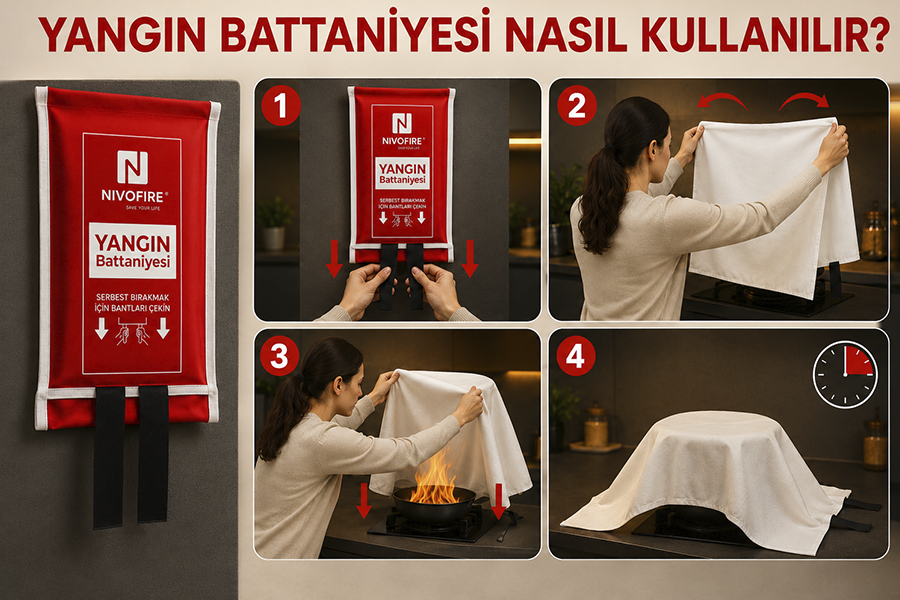
How to Use a Fire Blanket (Step-by-Step Guide)
Knowing in theory how to use a fire blanket is one thing; acting correctly without panicking during an actual fire is another. Here are practical steps that could save lives in a real fire:
- Use the pull tabs to remove the fire blanket from its packaging, holding the blanket so that your hands remain protected behind it.
- Approach with the blanket held like a shield. Keep it between yourself and the flames, and move toward the fire in a controlled manner.
- Slowly place the blanket over the flames to cut off the oxygen supply completely. Avoid sudden movements.
- Do not lift the blanket immediately. Even if the flames appear to be out, leave it in place for at least 20-30 minutes to prevent reignition.
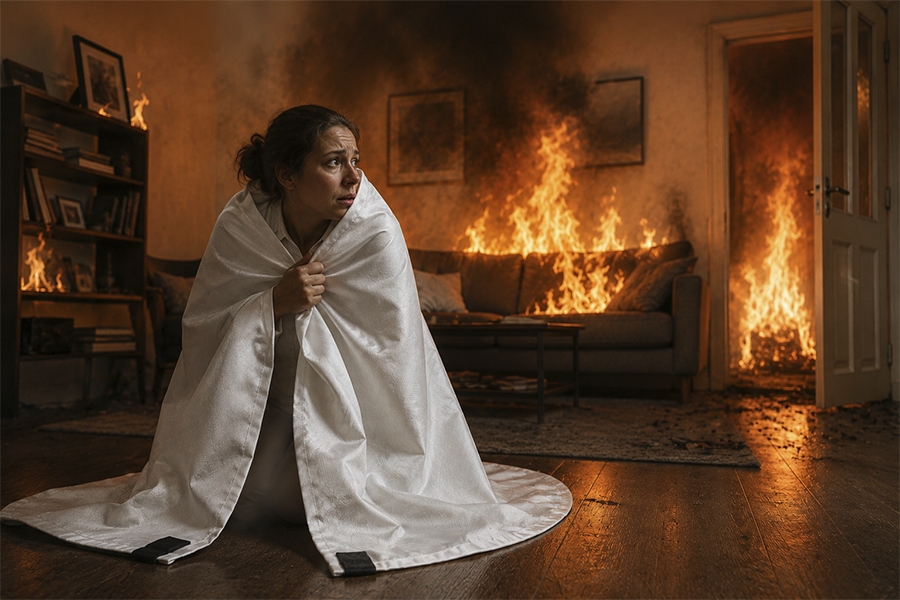
- For clothing fires, wrap the person in a fire blanket. Starting at the shoulders, use it to smother the flames, leave the face uncovered, and then contact emergency medical services.
- Check the blanket after use. If a standard fire blanket has been exposed to high heat, replacing it with a new one rather than reusing it is the safest approach.
Which Types of Fires Can a Fire Blanket Be Used On?
“How do you use a fire blanket?” The correct answer to this question is not limited to knowing how to deploy the equipment. For an effective response, the type of fire must first be assessed correctly. This is because a fire blanket does not produce the same result in every fire. The type of combustible material, the size of the fire, and its rate of spread directly determine which equipment should be used. Therefore, knowing which fire classes it can safely be used on helps prevent incorrect interventions and improves both personal safety and extinguishing effectiveness.
| Fire Type | Suitability | Description |
|---|---|---|
| Class A | Suitable | Solid combustible materials such as paper, fabric, and wood |
| Class B | Suitable | Small fires involving flammable liquids |
| Class F | Highly suitable | Hot cooking oils, including frying oil |
| Small electrical fires | Conditionally suitable | Safe if the power can be switched off. |
| Large industrial fires | Not suitable | Requires a professional fire-suppression system. |
Using a Fire Blanket in Different Situations
A frying pan that catches fire in a kitchen and a small fire that starts in an electrical panel cannot be handled in the same way. Similarly, the steps required to protect a person whose clothing has caught fire differ from those used for fires involving objects. The correct answer to the question “How do you use a fire blanket?” varies depending on the situation. The most common usage scenarios are as follows:
Use on a Kitchen Oil Fire
One of the most common mistakes in this type of kitchen fire is pouring water onto the burning pan. The water sinks beneath the hot oil and instantly turns to steam. During this process, droplets of oil scatter explosively. The resulting fireball can engulf the entire kitchen within seconds. The correct procedure is as follows:
- The gas or electricity supply to the stove is shut off.
- The fire blanket is held by two corners.
- Hands are protected by keeping them behind it.
- The blanket is slowly placed over the pan.
- It is not removed for at least 20-30 minutes. This is because, even if no flames are visible, the oil may still be hot enough to reignite.
Responding to a Person Whose Clothing Has Caught Fire
A fire blanket is used not only for fires involving objects, but also to protect people. A person running in panic causes the flames to receive more oxygen. In this situation, the person should be stopped, carefully wrapped in the blanket starting from the shoulders, and the flames should be completely smothered. The face should be left as exposed as possible. Do not apply excessive pressure during the response, and do not rub areas that have been burned. Once the fire is out, the blanket should not be removed immediately; first assess the person’s safety and call emergency medical services.
Use on Electrical Appliance Fires
The most significant risk with electrical appliances is that the power supply may still be active. Therefore, if possible, disconnect the power first. Then cover small flames with a fire blanket to cut off their contact with oxygen. However, lithium-ion batteries (such as those in electric scooters, laptops, power stations, and some electric vehicle batteries) are different. Chemical reactions can continue internally due to thermal runaway in the battery cells. Therefore, the blanket must not be removed until the reaction in the batteries has ended and you are certain that the flames are out. This distinction is one of the most important differences between fires involving standard electrical equipment and lithium battery fires.
Common Mistakes When Using a Fire Blanket
A significant proportion of problems involving fire-safety equipment stem from incorrect usage habits. At Nivofire, in the fire-safety training and field exercises we conduct across different sectors, we observe users repeatedly making the same mistakes. Especially in a moment of panic, even a small mistake can make the fire harder to control and can also endanger the person responding. Therefore, it is just as important to know which actions to avoid as it is to know how to use a fire blanket. Here are the most common mistakes…
- Throwing a fire blanket onto the flames from a distance.
- Removing the blanket before the fire is completely extinguished.
- Continuing to intervene even though the fire has grown.
- Moving the container holding the flammable liquid.
- Using a blanket when it is punctured, torn, or dirty.
- Being unable to reach the blanket for several minutes in an emergency because it has been stored inside a cupboard.
The last point, in particular, is often overlooked. The best place for a fire blanket is close to an area where a fire is likely to start, but not directly above the exact point where the fire could occur. For example, mounting it directly above the stove in a kitchen is not advisable; flames could make that area inaccessible. A wall location near the entrance and within easy reach is safer.
Can a Fire Blanket Be Reused?
There is no single answer to this question. Whether it can be reused depends on the purpose for which the blanket was manufactured and the product category to which it belongs. Standard fire blankets used in homes and workplaces are generally considered single-use equipment under commonly accepted practice. If a blanket shows no deformation after use on a fire, it may be possible to reuse it. However, this decision should not be based solely on visual inspection. Fiber damage that cannot be seen with the naked eye or heat-related performance loss in the fabric may reduce the level of protection in a subsequent fire. By contrast, professional Nivofire fire limitation blankets for electric vehicles, such as ALPHA and BETA, have been developed with a different use concept. These products are designed to be used multiple times, depending on the usage scenario, and offer solutions tailored to the operational needs of professional teams.
In practice, the safest approach is straightforward: if a standard fire blanket has been used to respond to a fire and exposed to high heat, replace it rather than reuse it. In fire safety, the real risk is relying on a damaged blanket in an emergency simply because it appears intact.
Where and How Should a Fire Blanket Be Stored?
A fire blanket should be stored where it can be reached within seconds. It should not be kept inside a cabinet or obstructed by other items; instead, mount it on a clearly visible wall. In homes, the safest location is near the kitchen but not directly above the stove. Keep the blanket in its original case and protect it from moisture, intense sunlight, and chemical exposure. Nivofire’s research shows that one of the most common problems is being unable to reach the blanket in time during an emergency. Positioning it correctly is therefore just as important as choosing the right blanket.
What Should You Consider When Choosing a Fire Blanket?
Not all fire blankets on the market offer the same level of performance. Do not select one based on size alone. Consider the following criteria when evaluating a fire blanket:
| Evaluation Criterion | Why Is It Important? |
|---|---|
| Fabric type | The blanket should be made from fiberglass or other technical fabrics resistant to high temperatures. |
| Size | Choose a size appropriate for the intended area of use; homes, kitchens, and industrial environments have different requirements. |
| Standards and certifications | The fire blanket should comply with EN 1869, which confirms that it has passed specified performance, durability, and safety tests. |
| Packaging design | The packaging should open in a single motion, and the pull tabs should be sturdy. |
| Manufacturer support | Give preference to manufacturers that provide technical documentation, training, and after-sales support. |