
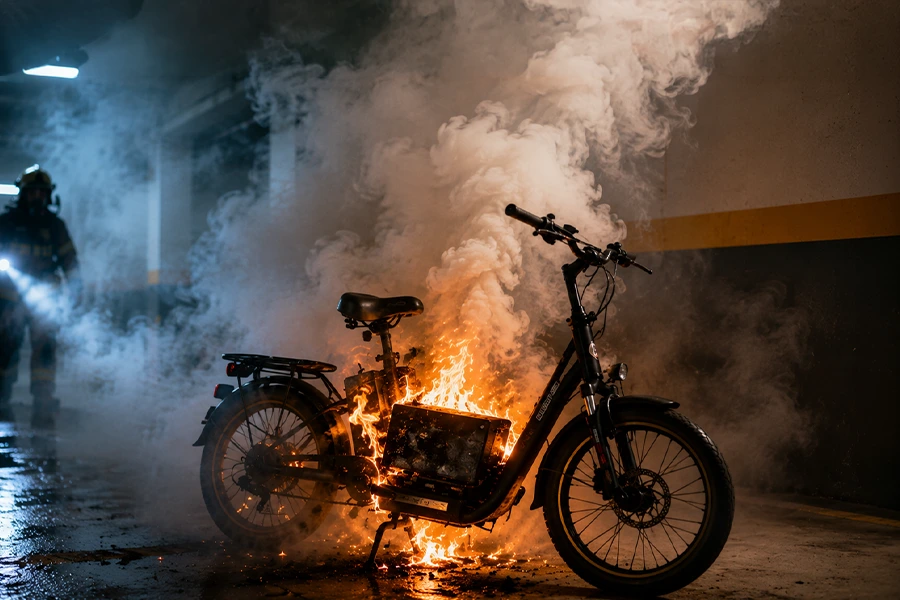
Electric bicycles make life in traffic-heavy cities quieter, more practical, and more economical, but they also introduce a new generation of fire risks. When an electric bicycle fire occurs, the danger is not limited to flames, as many people may assume. Equally hazardous are the toxic gases released into the environment within seconds during a lithium-ion battery fire. The dense white smoke produced during ignition may contain hydrogen fluoride (HF), carbon monoxide, volatile organic compounds, and other toxic gases that can seriously affect human health. In areas with inadequate ventilation, such as apartments, residential parking garages, retail stores, and enclosed storage facilities, these gases can become an even greater hazard than the fire itself.
The increase in electric bicycle fires in Europe and Türkiye in recent years shows that the risk is no longer merely theoretical. A 2026 case series published in the Journal of Plastic, Reconstructive & Aesthetic Surgery (JPRAS) clinically demonstrated that toxic gases released during electric bicycle battery fires can cause severe lung damage and potentially fatal respiratory failure. One of the most notable findings was that the patients’ clinical conditions could not be explained by burns alone. The researchers highlighted that toxic gases released during battery fires, particularly hydrogen fluoride, significantly worsened the clinical course.
As electric bicycle and scooter fires become more frequent, hospital burn centers and occupational health specialists are also paying closer attention to the issue. Unlike conventional fire scenarios, lithium-ion batteries burn through a difficult-to-extinguish chemical reaction, and the gases released during a fire may cause severe respiratory failure within hours of exposure. For this reason, describing an electric bicycle fire simply as a “battery explosion” can overlook the true nature of the risk.
From a fire safety perspective, these findings underline an important reality: in lithium-ion battery fires, the objective is not only to control the flames, but also to limit the spread of toxic smoke, reduce exposure for people in the surrounding area, and create a safer working environment for emergency response teams arriving at the scene. Therefore, fire limitation solutions developed for electric bicycle and scooter fires should be evaluated from a different perspective than conventional firefighting equipment.
Why Do Electric Bicycle Fires Occur?
Lithium-ion batteries used in electric bicycles provide long range and low weight thanks to their high energy density. However, this same energy density also means that an internal battery fault can rapidly develop into an uncontrollable chemical reaction. Electric bicycle fires are often described colloquially as a “battery explosion,” but the technical process is considerably more complex. The incident usually begins with internal damage in a single cell. Damage to the separator layer, contact between electrodes, or degradation of the electrolyte can result in an internal short circuit. This short circuit can trigger a chain reaction in which the battery continues to generate and feed itself with heat.
The main factors that can lead to a fire include:
- Using non-original chargers or chargers that are incompatible with the battery
- Continuing to use batteries that have sustained physical impact or damage
- Cell defects originating from manufacturing
- Battery Management System (BMS) failures
- Overcharging or unsuitable storage conditions
- Prolonged exposure to high ambient temperatures
- Continuing to use batteries that have reached the end of their service life
There is an important reason why battery fires may occur without obvious advance warning. A battery can appear completely intact from the outside, while microscopic damage inside the cells may progress for days or even weeks without producing visible symptoms. A fire often occurs while the battery is charging or when it reaches full capacity. For this reason, fire statistics show that a significant proportion of incidents occur in electric bicycles and scooters left charging overnight.
What Toxic Gases Are Released in an Electric Bicycle Battery Fire?
When an electric bicycle battery burns, the resulting smoke releases a far more complex chemical mixture into the air than an ordinary plastic fire. Electrolytes and fluorinated compounds inside the battery decompose at high temperatures, leading to the formation of various toxic gases. The gases most commonly identified and their potential effects are summarized below.
| Released Gas | Source | Potential Effects |
| Hydrogen Fluoride (HF) | Electrolyte decomposition | Chemical lung injury; eye and respiratory tract irritation |
| Carbon Monoxide (CO) | Incomplete combustion | Reduces oxygen delivery to tissues and may cause poisoning |
| Carbon Dioxide (CO₂) | Combustion reaction | May reduce oxygen levels in enclosed spaces |
| Volatile Organic Compounds (VOCs) | Evaporation of organic solvents | Dizziness, headache, and respiratory tract irritation |
| Fine Particulate Matter (PM) | Combustion products | Can penetrate into the deepest regions of the lungs |
Hydrogen Fluoride and Other Toxic Gases
Hydrogen fluoride is one of the most hazardous substances associated with lithium-ion battery fires because it is a highly toxic gas that can cause serious harm to human health. When gaseous HF comes into contact with moisture in the respiratory tract, it can form hydrofluoric acid. This can cause more than a burning sensation in the throat; it may lead to chemical injury extending from the bronchi to the pulmonary alveoli. The real-world impact of this risk was highlighted in a study published in JPRAS in 2026. Researchers evaluated two separate electric bicycle battery fires that occurred in enclosed spaces. Although both patients suffered thermal burns, toxic gas inhalation was identified as a major factor worsening their clinical condition. The treatment processes observed after hospital admission further demonstrated how serious the consequences of electric bicycle fires can be.
Case 1: Burns Were Brought Under Control, but Respiratory Failure Developed
In the first case examined in the study, the lithium-ion battery of an electric bicycle belonging to a man in his thirties caught fire while charging. Following the incident, the patient suffered burns covering 32% of his body as well as an inhalation injury. After being admitted to hospital with burns affecting approximately one-third of his body, burn treatment was initiated immediately. However, within hours, his respiratory function deteriorated rapidly, and imaging findings together with clinical assessments indicated the development of chemical pneumonitis.
Shortly afterward, the patient’s condition progressed to Acute Respiratory Distress Syndrome (ARDS), requiring prolonged mechanical ventilation support for survival. The researchers concluded that the severity of the burns alone could not explain the seriousness of the condition and assessed that toxic gases inhaled during the battery fire, particularly hydrogen fluoride, played a decisive role in the lung injury.
Case 2: The Patient Could Not Be Saved Despite Advanced Intensive Care Treatment
One of the most striking cases in the study was the second case, as it clearly demonstrated why electric bicycle battery fires require a different approach. A 37-year-old man suffered burns over 44% of his total body surface area and an inhalation injury after a lithium-ion electric bicycle battery caught fire while charging. The injured man managed to escape the building and was immediately taken to a local hospital by emergency medical teams. He had severe burns, and his respiratory condition deteriorated far more rapidly than expected. The intensive care team applied advanced life-support methods, including Extracorporeal Membrane Oxygenation (ECMO). However, the progressive lung injury could not be brought under control, and the patient died after an 18-day struggle for survival. One of the most notable details was that although his burns had begun to heal, the lung damage could not be reversed.
Nivofire Electric Bicycle Fire Blanket
At Nivofire, we work actively to raise awareness of the hazards associated with lithium-ion battery fires in electric vehicles. This study once again showed that hydrogen fluoride and other toxic gases released during lithium-ion battery fires in enclosed spaces may play an important role in the development of fatal respiratory failure. The case series clearly demonstrates why the first minutes of an electric bicycle fire are critical. Rather than waiting for the fire to grow, limiting the spread of flames and dense smoke at an early stage can facilitate evacuation and help reduce exposure risk.
Developed for this purpose, Nivofire electric bicycle and scooter fire blankets are designed to help delay the spread of flames to nearby vehicles and structures, limit the uncontrolled spread of dense smoke, and create a more controlled fire scenario until emergency response teams arrive. Particularly in enclosed parking garages, bicycle retail locations, service areas, and shared charging stations, these products are increasingly becoming an essential component of fire safety planning.
Why Are Electric Bicycle Fires More Dangerous Indoors?
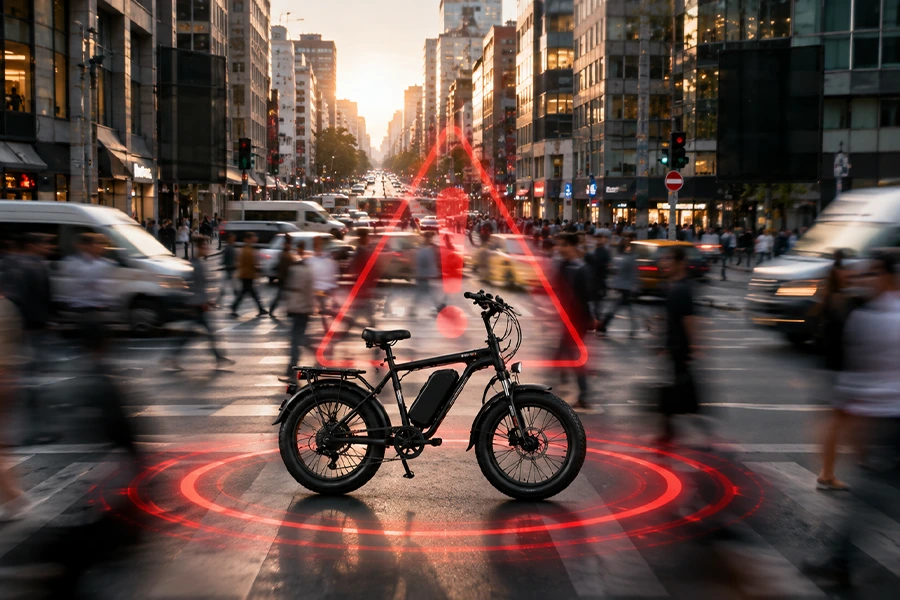
When an electric bicycle battery burns outdoors, the toxic gases produced can disperse to some extent under the influence of wind. When the same fire occurs inside an apartment, enclosed parking garage, bicycle store, or storage area, the scenario changes completely. In lithium-ion battery fires, the primary risk is not only the growth of the fire, but also the rapid accumulation of gases released at high temperatures within an enclosed volume. Experimental studies by the U.S. National Institute of Standards and Technology (NIST) show that dense smoke generated by electric scooter and similar lithium-ion battery fires can accumulate near ceiling level within a very short time before spreading throughout the entire space. Researchers report that visibility can decrease substantially within the first minutes of a fire while toxic gas concentrations rise rapidly. This shortens the available evacuation time and makes intervention more difficult for rescue teams.
Another major challenge in enclosed spaces is that areas away from the point of origin cannot necessarily be considered safe. Apartment corridors, stairwells, and enclosed parking garages in particular can allow smoke to move through natural air currents.
Factors that increase risk in enclosed spaces:
| Risk Factor | Potential Consequence |
| Multiple batteries located in the same area | Risk of cascading thermal runaway |
| Insufficient natural ventilation | Accumulation of toxic gases |
| Vehicles parked close to one another | Fire spreading to other vehicles |
| Unattended charging at night | Delayed fire detection |
| Limited escape routes | More difficult evacuation |
What Are the Warning Signs of an Electric Bicycle Battery Fire?
It is often difficult to predict an electric bicycle battery fire in advance, and batteries may begin to burn without any clear warning. However, before thermal runaway begins, a battery may show certain signs that can be detected through careful observation. Identifying these signs early can help prevent not only property damage but also serious injuries and exposure to toxic gases. For this reason, effective risk management begins with recognizing early warning signs rather than focusing solely on extinguishing a fire.
If one or more of the following signs are observed, the battery should not be considered safe and its use should be discontinued:
| Warning Sign | What It May Indicate |
| Battery becoming hotter than normal | An abnormal reaction may be starting inside a cell. |
| Swelling or deformation | Gas may be forming inside the cells. |
| Sharp chemical odor | Electrolyte leakage or gas venting may be beginning. |
| Hissing sound | Internal cell pressure may have increased. |
| White or gray smoke | Thermal runaway may have started. |
| Sudden temperature increase during charging | An internal short circuit or BMS failure may be developing. |
| Liquid leaking from the battery | Electrolyte damage may have occurred. |
What Should You Do in an Electric Bicycle Fire?
In an electric bicycle battery fire, the most important priority is not to attempt to extinguish the fire alone, but to protect life safety and limit the spread of the fire. Because lithium-ion batteries can reignite due to thermal runaway and can release toxic gases, the area should first be evacuated when a fire is detected, and the fire department should be informed that the fire is battery-related.
In enclosed spaces, it should be remembered that smoke can spread rapidly. Where possible, the affected area should be isolated to delay the spread of flames and smoke to other sections. At this stage, a fire blanket developed for electric bicycle and scooter fires can be placed over the burning vehicle to help limit the spread of flames and the uncontrolled dispersion of dense smoke. These blankets can provide additional time for evacuation and support safer intervention conditions for firefighting teams. However, it is important to understand that a fire blanket does not stop thermal runaway or completely extinguish the fire. Its primary purpose is to help control the effects of the incident, prevent escalation, limit the spread of toxic gases, and reduce the risk of damage to nearby vehicles and structures. For this reason, it is considered an important fire safety solution particularly for enclosed parking garages, bicycle stores, service points, and shared charging areas.
Evacuation, Emergency Response, and Actions to Avoid
An evacuation plan for an electric bicycle fire should not focus only on moving away from the flames; it should also take the direction of smoke movement into account. In enclosed spaces, smoke rises rapidly toward the ceiling and can then spread into corridors and stairwells. Therefore, simply leaving the room where the fire started does not always mean that a person is safe. The following steps summarize what should be done during evacuation:
- Call the 112 Emergency Call Center and clearly state that the fire involves a lithium-ion battery.
- Evacuate people from the affected area quickly and in an orderly manner. Because dense smoke in enclosed spaces may contain toxic gases, everyone should be directed to a safe area.
- If it can be done safely, cover the electric bicycle with a Nivofire Fire Blanket. The blanket can help delay the spread of flames to the surrounding area, other vehicles, and structures; limit the uncontrolled spread of dense smoke; and keep the effects of the fire more controlled until firefighting teams arrive.
- If it can be done safely, close doors to slow the spread of smoke into other areas.
- Ensure that anyone exposed to smoke is medically evaluated even if they do not show immediate symptoms. The effects of toxic gases such as hydrogen fluoride may, in some cases, appear hours later.
- Even if the fire appears to be under control, do not approach or reuse the battery. Because thermal runaway may continue in lithium-ion batteries, the possibility of reignition should always be considered.
Never do the following:
- Touch a burning battery with bare hands.
- Attempt to transport the battery by vehicle or elevator.
- Move your face close to the battery to identify the source of the smoke.
- Remain in the area simply because “the flames have gone out.”
- Reconnect a damaged battery to a charger.
- Move the battery into an enclosed storage area before the fire has completely ended.
What Does an Electric Bicycle Fire Blanket Do?
An electric bicycle fire blanket is specialized safety equipment designed to help control the spread of lithium-ion battery fires. When placed over a burning electric bicycle, it helps delay flames from spreading to nearby vehicles and structures and helps limit the spread of dense smoke and heat. In this way, it can provide additional time for evacuation and support safer intervention by firefighting teams.
The Nivofire Electric Bicycle Fire Blanket provides an effective fire safety solution for lithium-ion battery risks in electric bicycle and scooter parking areas, service centers, enclosed parking garages, repair workshops, and charging stations. Nivofire fire limitation blankets are designed to address different risk levels and usage scenarios, helping to keep fire conditions under control and limit potential damage.