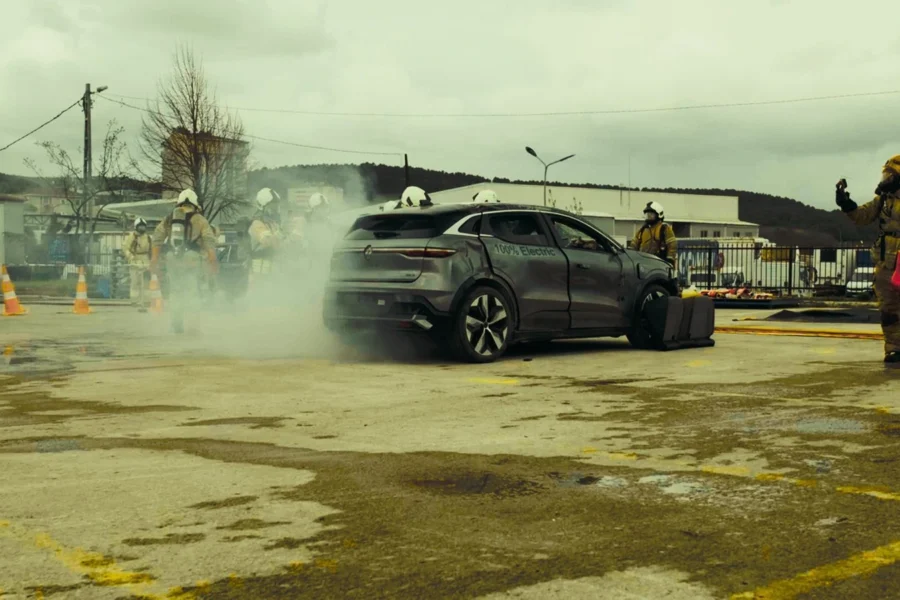
The field performance of response solutions developed for electric vehicle fires continues to be evaluated through practical drills. An electric vehicle fire drill organized by Nivofire with the participation of personnel from the Istanbul Büyükbakkalköy Fire Training Center also brought together representatives of numerous manufacturing companies from the industrial sector and firefighters serving in neighboring provinces. During this widely attended event, the Alpha Fire Containment Blanket once again delivered successful results.
Fully Electric Vehicle Used in the Seventh Drill
Having successfully completed six previous drills, the Alpha Fire Containment Blanket was deployed on a fully electric vehicle during its seventh test. Throughout the drill, the blanket’s performance in bringing the fire under control was observed on site by firefighting teams.
Making Fire Response Safer and More Efficient
Fires involving electric vehicle batteries require more challenging response procedures than conventional fires due to extreme temperatures and the risk of re-ignition. In such scenarios, the Alpha Fire Containment Blanket helps contain flames and intense heat, limiting the spread of the fire to the surrounding area. This supports firefighting teams in establishing a safer response zone.
By reducing the need for water, foam and dry chemical powder during fire response, the product improves operational efficiency and helps simplify the response process. This enables firefighting teams to manage the incident in a more controlled manner while also supporting efforts to reduce environmental impact.
Withstands Temperatures up to 2,500°C and Can Be Reused
Engineered to deliver exceptional resistance to high temperatures, the Alpha Fire Containment Blanket can withstand maximum temperatures of up to 2,500°C and has a continuous operating temperature of 1,500°C. Designed for multiple uses, its reusable construction provides organizations with an economical and sustainable solution.
Successful Test Series Continues
With the latest drill conducted at the Istanbul Büyükbakkalköy Fire Training Center, the Alpha Fire Containment Blanket successfully completed its seventh field test for electric vehicle fires, once again demonstrating its effectiveness in real-world response scenarios.
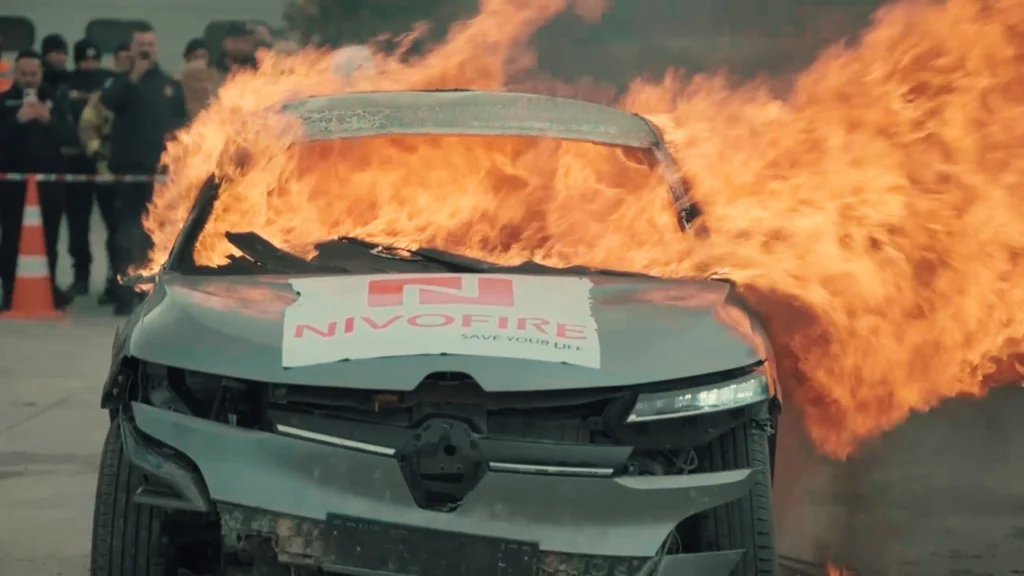
ELECTRIC VEHICLE FIRE DRILL REPORT
Date: 19/03/2025 Location: Büyükbakkalköy Fire Training Center, Maltepe/Istanbul Institution/Unit: Istanbul Metropolitan Municipality Fire Department
This report has been prepared based on data from a drill hosted by the Istanbul Metropolitan Municipality (IMM) Fire Department on 19 March 2025, in which a fire containment blanket was used as a response method for an electric vehicle fire.
Equipment Used
- Fully electric vehicle equipped with a 292 kg battery
- Nivofire Texograft Alpha Electric Vehicle Fire Containment Blanket, measuring 6 m x 8 m
- Laser thermometer, thermal camera, gas detector
- Hammer, pickaxe, sledgehammer
- Protective hood, firefighter helmet, breathing apparatus, fire proximity suit, heat-resistant gloves and boots
- Hose
- Nozzle
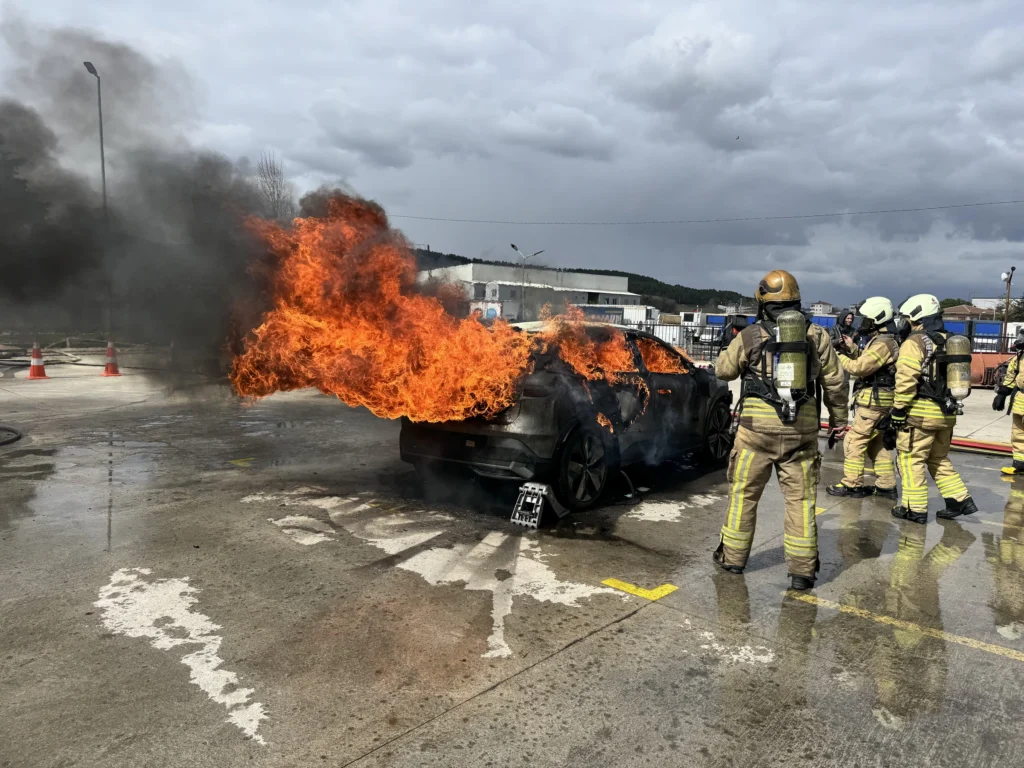
Evaluation and Observations
- Thermal runaway resulting from controlled physical damage to the battery caused flaming combustion.
- The fire blanket reduced the formation and spread of toxic gases to a low level and prevented the fire from spreading to the surrounding area. A limited amount of gas release was observed at points where the blanket was in contact with the ground.
- As re-ignition was observed even after the battery fire appeared to have been extinguished, it was assessed that the required response time is directly related to the battery’s capacity and state of charge.
- The blanket was observed to play a major role in preventing re-ignition.
- The reduction in temperature was observed to accelerate following spray cooling.
- No deformation such as puncturing, melting or tearing was observed on the fire blanket during or after the intervention.
Conclusions and Recommendations
- The drill once again demonstrated that the likelihood of re-ignition in electric vehicle fires is significantly high.
- It was concluded that an electric vehicle fire occurring in an enclosed car park or garage can spread rapidly and that response using conventional methods such as water, foam and dry chemical powder may be unsuccessful.
- Professional and expert observers recommended the use of additional response equipment, such as fire containment blankets, and enhanced precautions against fire risks in virtually all locations where electric vehicles and batteries are stored, operated or serviced.
- It was concluded that water-based response is effective only for cooling the fire and does not provide an extinguishing effect.
- The reusability of the Nivofire Alpha Fire Containment Blanket, used for the seventh time in this drill, was confirmed.
- It was observed that keeping the high-temperature-resistant blanket over the vehicle for an extended period enabled the battery to become safely inactive.
- Responding to an electric vehicle fire with a fire blanket was confirmed to be an effective and efficient method.
- Precautions must be taken against the risk of electric shock during response operations.