Use of Fire Blankets in Responding to Electric Vehicle Fires Classified Under Class L Lithium-Ion Battery Fires
Fires are among the leading incidents that threaten human life, cause material losses, disrupt operations and activities, resulting in economic damage and serious environmental harm. For this reason, various legal regulations have been implemented worldwide to ensure passive preventive measures are taken before fires occur, and active intervention methods are applied if fires occur despite all precautions.
Fire Classes According to ISO 3941:2007
The technical requirements that materials and systems must meet are defined by standards published by the International Organization for Standardization (ISO), which has more than 160 member countries. One of the fundamental standards for fire classification, ISO 3941, categorizes fires into different classes.
The ISO 3941:2007 standard originally defined five main fire classes:
- Class A – Solid material fires
- Class B – Liquid fires
- Class C – Gas fires
- Class D – Metal fires
- Class F – Cooking oil fires
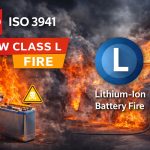
With the update made in January 2026, a new fire class was added to the standard:
- Class L – Lithium-ion battery fires
Class L lithium-ion fires are defined as fires involving lithium-ion cells and batteries that do not contain lithium metal.
Note: Class L fires are electrochemical fires and have higher energy density than most Class A, B, C, D, and F fires. This may result in faster fire growth when energy is released.
This definition highlights three key characteristics:
Electrochemical structure:
The combustible material behaves differently from conventional fires.
High energy density:
The amount of energy released is greater than in traditional fires.
Rapid growth potential:
Energy release may cause the fire to grow rapidly within a very short time.
Why Was a Class L Fire Definition Needed?
Today, mobile phones, laptops, cordless tools, robotic vacuum cleaners, scooters, electric bicycles, and electric vehicles have become an integral part of daily life. All these devices operate using batteries, and as their use increases, the potential fire risk also increases.
These fires behave differently from conventional Class A, B, C, D, and F fires. As a result, Class L fires also present the following additional risks:
- Uncontrolled heat transfer between cells (thermal runaway)
- Release of highly toxic gases (e.g., hydrogen fluoride)
- Physical barriers preventing extinguishing agents from reaching the cell core
- Burning cells being ejected with projectile effect
- Exposure to leaking electrolyte
- Release of hot and explosive gases
- Risk of electric shock
- Risk of re-ignition due to residual energy
These characteristics necessitate evaluating Class L fires as a separate category.
Intervention Methods for Class L Lithium-Ion Fires
Extinguishing agents used in conventional fire classes are summarized in the table below.
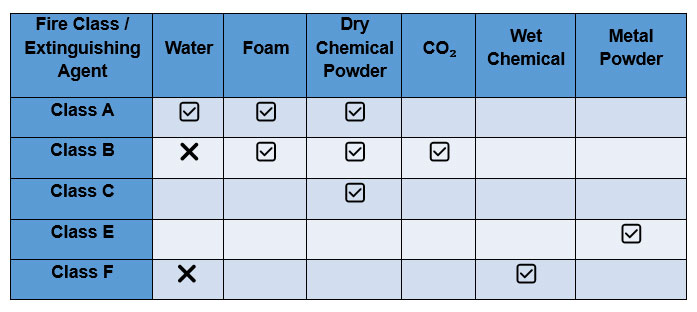
However, in Class L fires, water, foam, dry chemical powder, and chemical agents often cannot penetrate battery cells and are insufficient to fully suppress the fire. This leads to:
- Longer fire duration
- Increased release of toxic gases
- Higher consumption of water and chemicals
- Increased environmental damage
Currently, there is no dedicated extinguishing agent specifically developed for Class L fires.
When conventional extinguishing agents are insufficient, the primary objectives are:
- To contain and limit the fire quickly
- To prevent fire spread
- To reduce toxic gas emissions
- To minimize environmental damage during intervention
Intervention Method for Electric Vehicle Fires: Fire Blankets
Electric vehicle fires are among the most common examples of Class L fires.
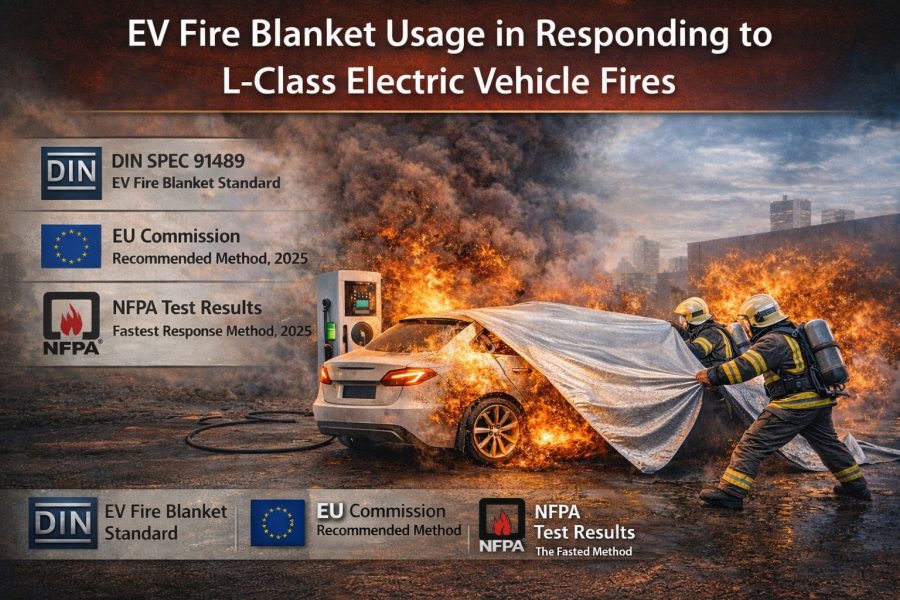
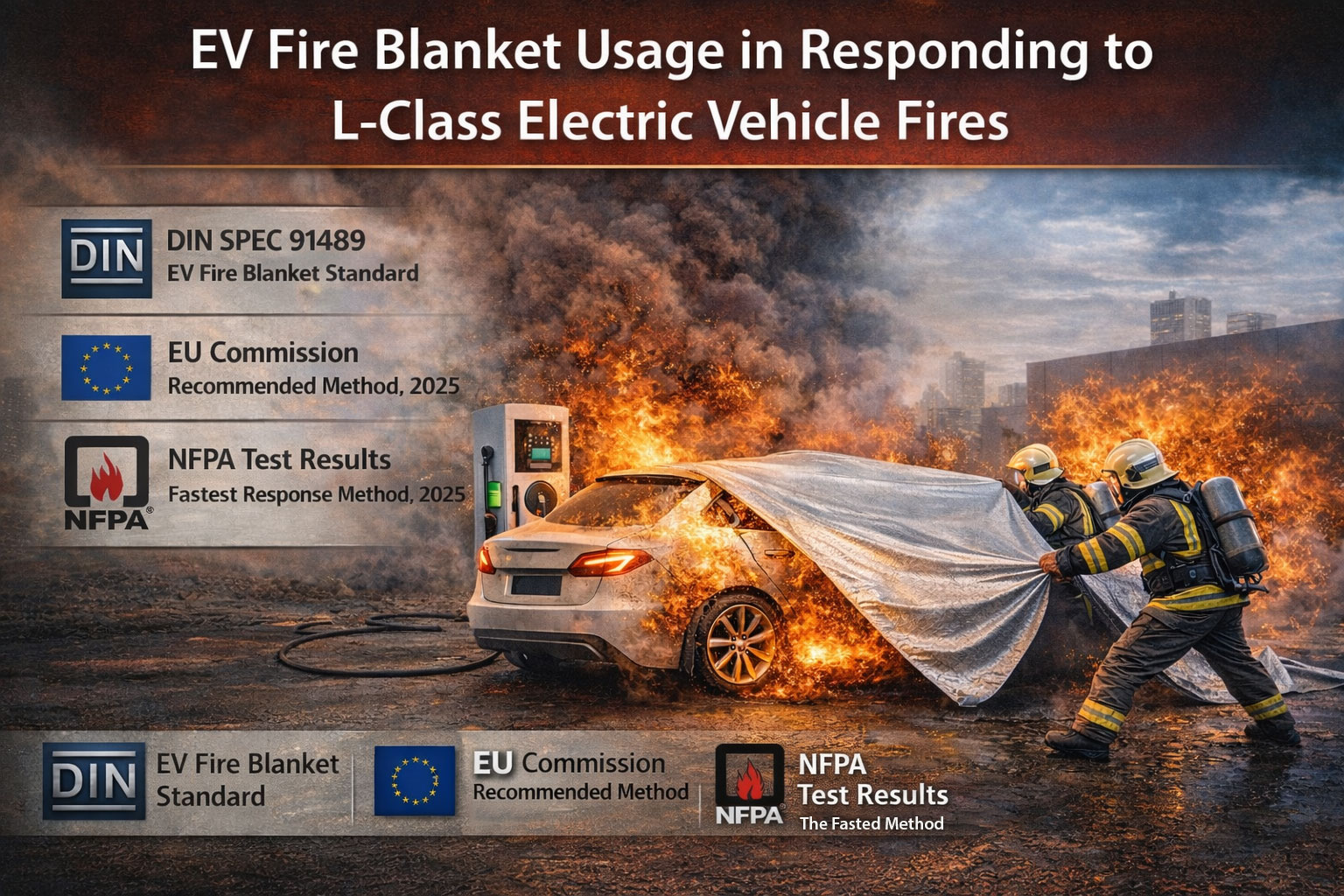
In this context, the DIN SPEC 91489 document published in Germany in November 2024 defines the technical requirements for fire containment blankets used in electric vehicle fires.
In the report titled “Fire Safety – Electric Vehicles and Charging Infrastructure,” published by the European Commission in 2025, fire blanket use was recommended as the primary intervention method for electric vehicle fires.
Similarly, in tests conducted by the National Fire Protection Association (NFPA) in 2025, four intervention methods were compared, and fire blankets were identified as the fastest for containing battery fires. Test results showed that fire blankets contained battery fires 2.4 times faster than other methods.
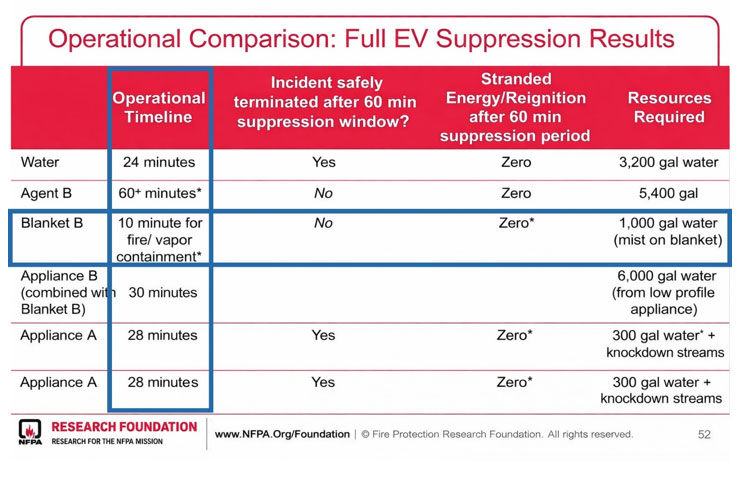
In some counties in the United States, as well as in South Korea and Malaysia, it has become mandatory to provide one fire blanket for every five charging stations.
Conclusion
Class L lithium-ion battery fires have different characteristics compared to Class A, B, C, D, and F fire classes.
Factors such as:
- High energy density
- Thermal runaway
- Toxic gas release
- Re-ignition risk
- Electric shock hazard
have made it necessary to classify these fires as a separate category.
Regarding the use of fire blankets in electric vehicle fires involving Class L lithium-ion battery fires:
- Technical requirements for fire blankets have been defined by DIN SPEC 91489
- The European Commission has recommended fire blanket use as the primary intervention method
- NFPA testing has demonstrated that fire blankets are the fastest intervention method
- Fire blanket use has been adopted by official institutions worldwide and implemented through regulations
As a result, standards, official reports, and global practices have confirmed that fire blankets are the most effective intervention method for electric vehicle fires powered by lithium-ion batteries.